Wednesday, October 31, 2012

The Armstrong/Hamilton Conundrum


Despite the title, this is not a post about a Big Bang Theory episode. This week, we're interacting (again) with humanity's seeming inability to grasp the moral complexity of the rest of humanity. As Lance Armstrong gets dumped by Nike, a major sponsor, is stripped of his Tour de France titles for doping, and steps down from the chairmanship of his Livestrong Foundation, talking heads (on TV and otherwise) wonder what to make of the man. After all, he has, almost through force of personal will, raised tens of millions of dollars for the fight against cancer. On the other hand, he has been cheating the system and self-righteously lying about it for more than 10 years. Bomani Jones, being interviewed on Dan LeBatard's Highly Questionable program, actually suggested that these two sides of Lance Armstrong were "mutually exclusive."

These Armstrong discussions come in the wake of Josh Hamilton's season as slugger and recidivist for the Texas Rangers. As this article illustrates, people are confused about what to make of Hamilton, too. Tellingly titled "The Prisoner of Redemption," the piece (by Grantland's Bryan Curtis) details the expectations that have been placed on Hamilton since he "cleaned up his act:"

The problem with The Story [of Hamilton's recovery from drug and alcohol addiction and development into one of baseball's best players] wasn't that Hamilton was telling it too much. The problem was that The Story was too perfect. Its happy ending left no room for a fourth act. Which is to say, the improbable, occasionally strange life that Hamilton was continuing to live and the odd turns of fate that would occur over the course of a baseball season. Here, we come to the 2012 Texas Rangers.
In February, Hamilton went out in Dallas and started drinking. At some point during the night, he called Ian Kinsler. Hamilton committed no crime, and a relapse is about the most predictable thing that can happen to an addict. But drinking didn't jibe with The Story. For if faith had helped Josh ward off Satan's stench, why was Satan back?
This question hovers over Lance Armstrong's head, too, though he doesn't have the added Christian dimension: How, if these are indeed good men (having raised so much money for charity and having played baseball so well), can they have acted so duplicitously (having cheated the sports world, lying about it for a decade, and going out for a night of drinking)?


How can Christians be such bad people sometimes?

We've spoken on many previous occasions of Martin Luther's famous formulation simul justus et peccator ("at the same time justified and sinner"), and it will serve us well to discuss it here. St. Paul (a...duh...saint, and author of two-thirds of the New Testament) asked God to remove a thorn of perpetual sin and struggle from him (2 Cor 12:7) and called out for rescue from his "body of death" (Rom 7:24). He described the Christian life (or more accurately, the human life) perfectly with those astoundingly apt words in Romans 7:
I do not understand what I do. For what I want to do I do not do, but what I hate I do...For I have the desire to do what is good, but I cannot carry it out. For I do not do the good I want to do, but the evil I do not want to do -- this I keep on doing (vv 15, 18-19).
Of course Josh Hamilton and Lance Armstrong have led lives that seem to belie all the good they've done: they're human (peccator). In a funny way, Bomani Jones was right: our two states are mutually exclusive, but that doesn't keep them both from being true at every moment, all the time. How sweet, then, is the news that our savior came to save (justus) those who consistently slip back into sin, who know what they ought to do but cannot carry it out, and who consistently fail. Christianity is not a religion to help bad people get better, but a religion to get bad people saved.

Monday, October 22, 2012

The Fosbury Flop (and the High Bar of the Law)


It’s autumn now, which means that everyone can begin dreading stewardship season at church again. Preachers dread preaching it, congregants dread hearing about it, and everyone dreads being told how it all turned out. We’d all much rather think happier thoughts, like, perhaps, thoughts about the Fosbury Flop.

Dick Fosbury invented his “flop” (or at least brought it to the world’s attention) in the 1968 Summer Olympics.  It involves jumping over the high jump bar backwards, and landing on your back. It revolutionized the sport immediately, initiating an extended season of new world records. It was long entrenched as the only legitimate method of clearing a high jump bar by the time I began high jumping, in 1996.

I was a good high school high jumper, which is to say that I had no prayer of high jumping on the college level. I qualified for the regional meet, and could jump my height (a traditional benchmark). This meant that, in the main, I won or placed in most of the district and one-on-one meets in which we participated. Being among the best came with some perks. A good high jumper can use strategy to jump higher in meets or to psych out opponents…but sometimes, this strategy comes back to bite you.

Since the final standings of a high jump competition are determined simply by ranking the highest height cleared, jumpers can choose to pass on attempting lower heights, saving their legs and energy for higher jumps. This can also intimidate other jumpers, as in, “I’m nearing my personal best and that guy hasn’t even started yet!” I would often smugly pass lower heights, hoping my rattled opponents would fault out of the competition.

This is the mindset that a rich young man had when Jesus told him that, to be saved, he needed to obey the law: “all these [laws] I have kept since I was a boy” (Mark 10:20). “That’s child’s play!” he might as well have been saying, “I don’t even need to try!” In other words, he’s saving himself for the tougher jumps, the higher heights, the more challenging feats of obedience.

Then Jesus raises the bar.

At one district meet, I passed height after height, drunk on the scared looks I was getting from my inferior competitors. When I finally deigned to take off my sweats, a funny thing happened: I couldn’t clear the bar. Well, it was funny to everyone but me. There’s nothing quite so mockable as a high jumper who finishes a competition with no height cleared and in last place; especially one who has been so visibly unconcerned about lower heights.

When the rich young man comes face to face with the high bar of Jesus’ law, that to be saved he must sell all he has, give the proceeds to the poor, and follow Jesus, he goes away sad, “for he had many possessions” (Mark 10:22). He’s come face to face with a bar that he can’t clear.

As “stewardship” becomes a topic of conversation in our churches, let’s remember how high the bar is: everything you own. We consistently believe that the bar is low enough to clear: 10%. So we wave dismissively: give us a challenge. We tithe, and think ourselves righteous. But when Jesus raises the bar, we realize that the standard is too high for us, that the bar has been placed far above our heads. The standard is not 10%, 20%, or even 50%…it’s everything.

Jesus raises the bar for a specific purpose: We need to be brought into touch with our failures in order to recognize our need for a savior. The rich young man is confident in his high jumping ability. He could jump that high as a child! So he must be shown his need. Jesus knows that the first word of God (the law) must be understood in all its destructive power before the second word of God (the Gospel) can be accepted.

When the disciples see how this interaction ends, they ask, “who then can be saved?”  Jesus answers with God’s two words: First, he destroys: “with man it is impossible.” Second, he comforts: “But not with God. With God all things are possible.”

Who can be a good steward? No one. With man it is impossible. But not with God. With God, we have been called good stewards, in Christ, no matter how egregiously we fail and crash once more into the high jump bar. Where the rich young man went away sad, crushed by the law, we can stay, acknowledge our failure, and be saved.

Tuesday, October 16, 2012

Slugger, Redeem Thyself


The Yankees are going down in flames, and they're doing it in a way that no one expected: the Bronx Bombers can't hit!  Long known for using their high-priced murderer's row offense to make up for shaky starting pitching, the 2012 Yankees and losing close, low-scoring games because they can't score any runs.  Alex Rodriguez takes most of the blame because of his overwhelming contract and suspicious, mirror-self kissing, ways, but he doesn't even have the lowest postseason batting average on the team.  Robinson Cano, a perennial MVP candidate and fan favorite, does not have a hit yet this Fall, setting an all-time (in a sport that's been around and keeping stats since the 19th century!) record for postseason futility. 

Yankees fans, used to cheering the long ball, are growing frustrated.  A few days ago, a fan took the time to paint the sign at left and bring it to The House That Ruth Built (Yankee Stadium).  Big thanks to Dan Siedell over at LIBERATE for this picture, and be sure to check out his amazing thoughts on the intersection between the Gospel and art HERE. How do you think A-Rod feels, looking up into the stands and seeing this sign?  I know how I would feel!  I'd want to jump over the wall, clamber up to that fan's row, and scream in his face, "Look, I'm TRYING to get hits! Don't you think I'd be playing better if it was up to me? Don't you think I'd redeem myself if I could?"

Self-redemption is every human being's fondest hope, but it's also our impossible dream. In sports, people always talk about the disaster that can come from trying to make up for failures on the next play. Coaches always chide athletes to have a short memory; if you go into the next play, the next match, or the next game trying to make up for the mistakes of the previous one, you'll usually only compound them. The assertion is simple: we can't redeem ourselves.

The parallel to Christianity here is so obvious that it probably doesn't even need to be drawn. Humans refuse to believe that we are beyond helping ourselves; in fact we often protest that God only helps those who do!  We dearly wish that we could, ourselves, atone for the mistakes of the past, and say "Thanks but no thanks" to the offered atoning death of another.  We're uncomfortable owing someone so much.

We only acknowledge our need for a savior when the idol of self-salvation is unceremoniously ripped from our grasp. Alex Rodriguez, and the rest of Yankees, are almost there. One suspects that Justin Verlander will serve as the Hammer of God, finally convincing the Yankees, and their fans, that a savior from within is not enough.

Wednesday, October 10, 2012

I Would Never Do That: Denial and Cheering a Downed Quarterback

On Sunday, the crowd at Kansas City's Arrowhead Stadium was getting tired of quarterback Matt Cassel's poor play, so they began to chant backup quarterback Brady Quinn's name. As the saying goes, the most popular player on the team is the backup quarterback. For this to be true of a player like Brady Quinn can only stand either as a testament to the putridity of Cassel's performance or a case of collective amnesia afflicting the stadium. Chanting the name of the backup quarterback, of course, isn't rare (see: Tebow, Tim), but what is rare is what happened next.

In the fourth quarter, Cassel had to leave the game with a head injury. As Cassel lay on the turf after the hit that injured him, his home crowd seemed to cheer in relief. "Finally! No more Cassel!" the cheer seemed to say. The stadium certainly cheered as Quinn entered the game. Here is Chief's lineman Eric Winston reacting strongly after the game:


Whoa.

On yesterday's Pardon the Interruption, Tony Kornheiser suggested that if this happened (there's some disagreement about whether the cheering started when Cassel went down or if it began as he made his way off the field; it is common to cheer injured players leaving the field, as a way to let them know that the fans are behind them) it was illustrative of the "darkest part of human nature." Interestingly, both Kornheiser and his co-host Michael Wilbon expressed surprise that this kind of thing could happen in Kansas City, traditionally believed to be home to one of the nicest and most loyal fanbases in the NFL.

As they expressed their surprise, I couldn't help but think of the similar surprise that Christians express when their heroes falter. Ted Haggard comes immediately to mind. "Really?" we exclaim. "Him? How could someone who seemed so faithful fall so far?" I've heard the Christian life illustrated as the climbing of a ladder, and I'm willing to accept this image if we can agree that the ladder is infinitely tall and that each rung we've climbed immediately disappears beneath us. In other words, we're always on the last rung, hanging on for dear life.


The impulse that led Kornheiser and Wilbon to assume that the denizens of Kansas City were above cheering a quarterback's injury is the same impulse that allows us to convince ourselves that we (and other, similarly advanced, Christians) would be above that kind of thing, too. It only takes the right situation, however, to show us that our hold on that ladder was tenuous at best and that our falls can be as spectacular as anyone else's.

The tragic irony of the ladder illustration is, of course, Jesus' stated intention to save those lying in a crumpled heap at the bottom of it while having nothing to do with those proficiently climbing. The longer we continue to convince ourselves (falsely) that we are in good standing and out of trouble, the further we remove ourselves from the outreached hand of our savior.

Wednesday, October 3, 2012

"Earn This" and the Law of Saving Private Ryan


James Ryan walks through the American Cemetery in Normandy, an old man. He stops at a headstone, and falls to his knees, tears in his eyes. The headstone reads: John Miller. As Ryan’s wife comes to his side, he says through his tears, “Have I been a good man? Tell me I’ve lived a good life.” Moved, his wife assures Ryan that he has. Yet the tears don’t abate. James Ryan can’t be sure if he’s been good enough.

In Saving Private Ryan, Steven Spielberg marshals a wonderful ensemble cast to tell a wonderfully scripted, beautifully shot, movingly acted, and soul-crushingly judgmental story. John Miller is tasked with taking a squad of 8 men to find just one. Private James Ryan is the fourth son of a woman who has lost the other three in World War II. It has been decided that she will not lose a fourth. Miller’s squad eventually loses every man in the effort to save Private Ryan.

Miller meets his own end defending a bridge by Ryan’s side. With his last breath, he looks at Private Ryan and whispers, “Earn this.” With these words, he dies. We flash sixty years into the future, and the octogenarian Ryan has clearly lived his entire life with this great weight on his shoulders. Has he indeed earned the salvation that Miller’s squad gave their lives for? Miller himself, earlier in the film, muses, “He better be worth it. He’d better go home and cure a disease, or invent a longer-lasting light bulb.” Has he discovered a cure for malaria? Has he invented cold fusion? That awesome upside-down ketchup bottle? As viewers, we aren’t given to know. What we do know, however, is that he’s worried. Why else does he beseech his wife to comfort him? We see that he has a beautiful family. His wife tells him he has been a good man. Clearly, leading a good life has not freed him from the judgment of Miller’s words.


Christians too often hear these words, “Earn this,” coming from Jesus’ lips as he dies on the cross. We hear sermons to this effect: “Is the life you’re living worth the death he died?” We live our lives trying to earn it, to become someone for whom such a sacrifice isn’t so radically inappropriate. We turn into old James Ryans, worried that it hasn’t been quite enough. The most shocking revelation of the film is that Ryan’s wife has no idea who John Miller is! Miller’s judgment has been so heavy that Ryan has not been able to share his name or story with his beloved for his whole life!

But Jesus doesn’t say, “Earn this” from the cross. He says, “It is finished.” Even more radically, he says, “I tell the truth, today you will be with me in paradise.” The message of the Gospel is diametrically opposed to John Miller’s “Earn this.” Miller applies the law to Ryan’s future in a way that Ryan can never escape. No matter how profound an altruist Ryan may become, the profundity of Miller’s sacrifice will never allow Ryan to feel satisfied, or safe from Miller’s judgment-from-beyond-the-grave. One word of law destroys the grace Miller shows in sacrificing his life for Ryan. But it is not so with Christ.

No word of law escapes Christ’s lips from the cross. Incredibly, the word of law is applied to Christ (“My God, my God, why have you forsaken me?”). We are freed, and safe. We don’t feel compelled to hide what Jesus has done for us, as Ryan hid what Miller did for him, because Jesus expects nothing of us. Our Savior doesn’t say, “Earn this.” He says, “It is finished…you will be with me in paradise.”

Wednesday, September 26, 2012

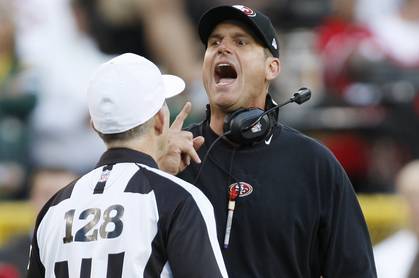
The Law and Death of Replacement Referees


The internet exploded yesterday. At least, the sports corner of it did. For those not in the know, the NFL has been operating this season with replacement referees, having locked out the unionized regular refs in a contract dispute. The replacements have performed, depending on whom you ask, anywhere from "predictably shaky" to "seismically catastrophic."  Monday Night's performance, though, was one for the ages.  Calls were missed or made incorrectly all game long, but the coup de grace was a time-expired Hail Mary pass that seemed, in replay, to be awarded to the wrong team, completely altering the outcome of the game. For the first time, it seemed inarguable that the replacement refs had cost a team a game.

The narrative after the game has only gotten more strident: these replacement refs are doing a job that they're not qualified to do.  Most of them are lower-division college or semi-pro refs; one of them even has the Lingerie Football League on his resume.  They're simply incapable of doing the job (controlling and administering the rules for the best, meanest, and most out-of-control athletes on the planet) that they've been given. Don't you feel for them?


St. Paul says that "sin, seizing the opportunity afforded by the commandment, deceived me, and through the commandment put me to death" (Romans 7:11).  When Moses came down the mountain with those commandments, and then Jesus clarified and sharpened them in the Sermon on the Mount, we were given a job that we're not qualified to do, a task that is beyond us. We look as hopeless in our trying as the replacement refs looked on Monday night. But, as Paul also says, "I would not have known what sin was had it not been for the law" (Romans 7:7).  We wouldn't know how hard it is to referee an NFL game if the replacement refs hadn't failed so spectacularly. We wouldn't know how far from the righteousness of God we are if the commandments hadn't been brought down from the mountaintop to show us.

Failure, though, is the only thing that leads to an openness to salvation.  As NFL fans cry out (caution, naughty words) for the salvation of the real refs, they might as well be quoting Paul: "Who will rescue me from this body of death?" (Romans 7:24) It is to a dying man that a savior comes.  Jesus promises to be that savior for his creation (Paul rejoices, "Thanks be to God, who delivers me through Jesus Christ our Lord!")...we can only hope that the real refs come back before He does.

Wednesday, September 19, 2012

Aristotle is of Two Minds about Jay Cutler


In sports journalism, athletes are constantly being referred to as "embattled." Perhaps quarterbacks are given this label more than any other athlete. It's safe to say then, that embattled Chicago Bears quarterback Jay Cutler is one of the more embattled people in the world. Sort of like how The Dude is the laziest man in Los Angeles county, which puts him near the front in the running for title of laziest, worldwide.  Cutler is a highly talented thrower with a knack for juxtaposing every breath-catching feat with a jaw-dropping interception. It doesn't help that his default facial expression is "I am sorely annoyed that I must be in your presence right now; I'd much rather be yelling at my pool cleaner. Oh, and I just ate something sour and am considering spitting it out."  It seems, though, that that's just the face God has given him.

A couple of years ago, Cutler had to leave the NFC Championship game with a strained ACL, and caught hell for it across the league, in real time, on Twitter. Last year, Cutler had the Bears playing really well, and on the road to the playoffs again, when he broke his thumb making a tackle, ending his season and the Bears' hopes. This season, he has played one great game, leading the Bears to 41 points in a week 1 defeat of the Indianapolis Colts, and one terrible one, throwing four interceptions during a week 2 drubbing at the hands of the Green Bay Packers.  Grantland's Bill Barnwell wrote this week about the Cutler phenomenon:
The problem is that we've somehow convinced ourselves that quarterbacks mill around at one level until they have a notably impressive game or season and establish a permanent new level of play, like they were characters in an RPG. That's nonsense, but we've spent the majority of Jay Cutler's career trying to pinpoint the moment in time when he took that big leap forward. We were sure Cutler had emerged as a franchise quarterback when he won that epic 39-38 game over the division rival Chargers in 2008. We were positive Cutler had taken the leap when he pushed a team whose most notable receiver was Devin Hester to an 11-win season and the NFC Championship Game in 2010. And we were definitely 100 percent onboard with the new Jay Cutler who led his team to a five-game winning streak last year just as he suffered a season-ending thumb injury. We keep telling ourselves that we've found the real Cutler, a guy who has eliminated his old faults and won't go back up the pipe to World 1-1.

The reality is that Cutler has followed up each of those big moments with disappointments, and we've used them as proof that Cutler's really a fraud and that those triumphs weren't actually meaningful after all. That shouldn't be a referendum on Cutler. It should be a referendum on us, the fans who are reading good and bad games as unassailable proof of Cutler's ultimate value as a player when they're really just peaks and valleys.

In his Nicomachean Ethics, Aristotle argued that you could tell what kind of a person someone was by evaluating their actions.  Does good things? Good man.  Does bad things? Bad man.  This is what Barnwell argues we do with Jay Cutler: throws touchdown? Good quarterback. Throws interception? Bad quarterback. Since Cutler does both of these things (though, as Barnwell notes, Cutler's "peaks and valleys tend to be more extreme...than they are for other players") we constantly flip back and forth between regarding him as a quarterback who has "finally figured it out" and one who won't ever "figure it out." We never attempt to get down to the root of the man because we are blinded by Aristotle (slightly more specific than being blinded by science itself). It is as hard for us to accept a person doing both good and bad things as it us for us to accept a quarterback who throws both touchdowns and interceptions...but of course this is the way things are. Quarterbacks (even Tom Brady and Peyton Manning...see Monday Night's game) throw both touchdowns and interceptions. People do both good and bad things. We must be considered more thoughtfully.

God tells Samuel that he "does not look at the things people look at. People look at the outward appearance, but the Lord looks at the heart" (1 Sam 16:7), and unfortunately (as Jeremiah put it) "the heart is deceitful above all things and beyond cure. Who can understand it?" (17:9) Perhaps a more properly ethical way for us to judge our quarterbacks is to see them as incurable interception machines who are miraculously given to throwing touchdown passes from time to time. From that vantage point, Jay Cutler looks more blessed than most. Perhaps, then, with that kind of eye, we can even turn a more merciful glance to our own interception/touchdown rate.